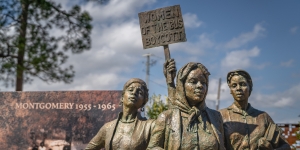
Join us in Montgomery
Experience the power of confronting injustice in this place, fueled by the deep knowledge gained at the Legacy Sites.
1955-1965
1955
The Montgomery Bus Boycott launched the modern civil rights movement in America. It is widely regarded as one of the most influential organized campaigns in world history.
Many think it started with Rosa Parks getting arrested and ended with Dr. King proclaiming victory. But it grew from decades of violence and humiliation and dozens of arrests on buses, until Rosa Parks’s arrest and conviction became the last straw.
And it took an army of tens of thousands cooking food, organizing carpools, fixing and fueling cars, and protecting and inspiring people to keep going for more than a year.
By 1860, enslaved Black people made up two-thirds of the population of Montgomery County. Montgomery was the capital of the domestic trafficking of enslaved people in Alabama, and more people were enslaved in and around Montgomery than any other Alabama city.
Despite the promise of Emancipation, opponents of racial equality had regained power in Alabama by the turn of the century. The Alabama Constitution of 1901, adopted explicitly to “maintain white supremacy,” codified a rigid and extensive system of racial segregation—prohibiting marriage between white and Black people, mandating separate schools for Black and white children, disenfranchising most Black men, and creating a legal system of second-class citizenship for Black people that would last for generations. It even barred Black and white people from playing checkers together.
As a result, Black Montgomery residents moved in separate spaces from white people—except on city buses, where Black and white people “were segregated under the same roof and in full view of each other.” Because there were no Black-only buses, Black riders could not avoid daily racial segregation, humiliation, and physical abuse on Montgomery’s buses.
Virtually every Black resident directly experienced mistreatment at the hands of white bus drivers and white passengers. This unrelenting and unavoidable humiliation fueled one of the most prominent mass campaigns for racial equality in U.S. history—the Montgomery Bus Boycott.
1940s
Buses became the primary space for unavoidable racial humiliation in the city—and Black women were the main targets of abusive bus drivers.
In the 1940s, several Black bus passengers were arrested on Montgomery’s public buses for sitting in “white-only” seats, including Ella Ree Jones, a student at Alabama State College who was arrested and violently beaten by police in July 1942 after she refused to give up her seat.
1954
Founded in 1946 by Alabama State professor Dr. Mary Fair Burks, the Women’s Political Council grew to over 200 Black women spanning three chapters. In 1950, under Jo Ann Robinson’s leadership, the group set its sights on rampant abuses on city buses, fueled by the police killings of three young Black men on Montgomery buses between 1950 and 1953.
Four days after the Supreme Court’s May 17, 1954, decision ruling racial segregation in schools unconstitutional, the WPC sent a letter to the mayor threatening a boycott if injustices on city buses were not addressed. A growing number of Black residents were already deciding to “[arrange] with neighbors and friends to ride to keep from being insulted and humiliated by bus drivers,” the WPC wrote, adding that Atlanta, Macon, Savannah, and Mobile had integrated buses without issue.
For the first time, the WPC informed the mayor that more than 25 local organizations had made plans for a citywide boycott of the buses if conditions did not improve.
Montgomery officials refused to make changes.
1955
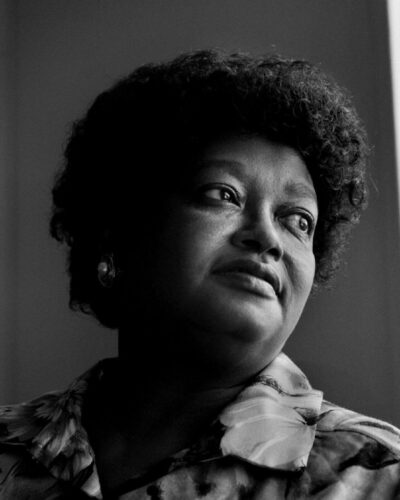
Claudette Colvin, Aurelia Browder, Mary Louise Smith, and Susie McDonald were arrested within a seven-month period for refusing to give up their seats to white riders.
By 1955, Black people in Montgomery had endured decades of humiliation, harassment, assault, and arrests on racially segregated city buses.
1955
Four days later, she was found guilty of violating racial segregation laws and fined. Black residents led by the Women’s Political Council seized the moment to launch a boycott of city buses.
1955
Despite the inclement weather, the first day of the Boycott was a huge success. The buses “carried nothing but white passengers from front to rear.” That evening, six thousand Black residents gathered at Holt Street Baptist Church, where after a rousing speech by the Rev. Dr. Martin Luther King Jr., they resolved to boycott local buses until the buses were desegregated.
Nearly every Black resident in Montgomery—50,000 Black people—took part in the Montgomery Bus Boycott and refused to ride city buses. They walked, biked, took taxis, carpooled, and even rode mules for 382 days.
1956
Boycotters were arrested, beaten, and shot at, and their cars were vandalized and homes bombed as tens of thousands of white residents organized to uphold racial segregation in Montgomery.
1956
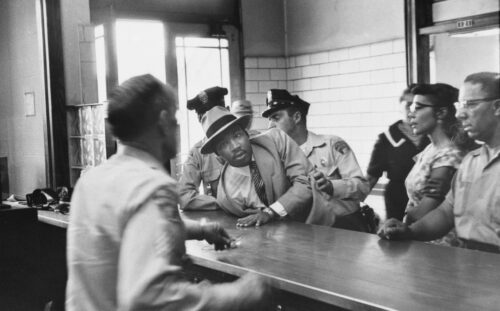
Police began arresting Boycott participants for minor or imagined traffic violations.
Dr. King was arrested for allegedly driving 30 miles per hour in a 25-mile-per-hour zone.
1956
The home of Dr. King and Coretta Scott King was bombed. Two days later, the home of Boycott leader E.D. Nixon was firebombed.
The house of the Rev. Robert Graetz, a white pastor supportive of the Boycott, was bombed.
1956
Some 12,000 white residents attended a mass White Citizens' Council meeting at the Montgomery Agricultural Coliseum in opposition to integration
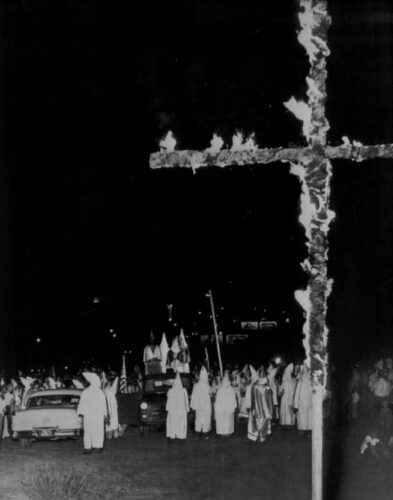
At least 1,200 white people attended a Ku Klux Klan cross-burning rally at Paterson Field, announcing the re-establishment of the KKK in Montgomery after 25 years
In February 1956, a Montgomery County grand jury returned indictments against 115 protesters for allegedly violating a 1921 anti-boycott law. In the face of violent threats and economic retribution, the indicted women and men courageously turned their arrests into badges of honor.
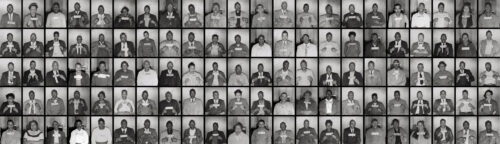
1956
The named plaintiffs were Aurelia Browder, Susie McDonald, Claudette Colvin, and Mary Louise Smith. City officials retaliated by attempting to have Mr. Gray prosecuted and disbarred.
1956
The city refused to integrate and instead filed an appeal.
1956
In the following weeks, acid was splashed on the cars of some 20 Black leaders. Witnesses said some of the assailants were uniformed police officers.
1956
Mob members burned a 40-foot cross outside city limits off Old Selma Road.
1956
The board said it would “do all in its power to oppose the integration of the Negro race with the white race in Montgomery, and will forever stand like a rock against social equality, intermarriage, and mixing of the races in the schools.”
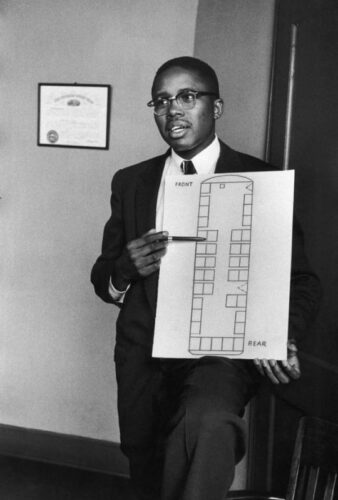
1956
The Supreme Court ordered the city to immediately implement its November 13 ruling in Browder v. Gayle prohibiting segregation on Montgomery’s buses. The next day, in a major civil rights victory, Rosa Parks and thousands of Black residents rode Montgomery’s buses and sat wherever they chose with no racial segregation for the first time.
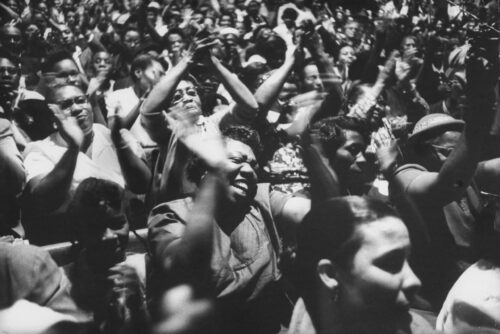
During the Montgomery bus boycott, we came together and remained together for 381 days. It has never been done again. The Montgomery boycott became the model for human rights throughout the world.Rosa Parks
The Montgomery Bus Boycott launched a decade of activism, organizing, and litigation that would dismantle legalized racial segregation in America.
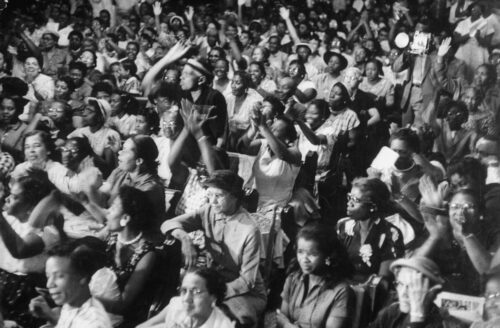
1960
Alabama Gov. John Patterson demanded that the student organizers be expelled and threatened to pull funds from the university if the school’s president did not comply. Hundreds of Alabama State students marched on the Capitol in protest.
On March 2, 1960, the college expelled the nine student leaders of the sit-in. More than a thousand students staged days of demonstrations and dozens were arrested. The state board of education ordered a “purge” of “disloyal” faculty members, including Women’s Political Council president and Bus Boycott leader Jo Ann Robinson.
Fifty years later, the nine students were formally reinstated by the university and their protest was recognized as an important moment in civil rights history.
1960
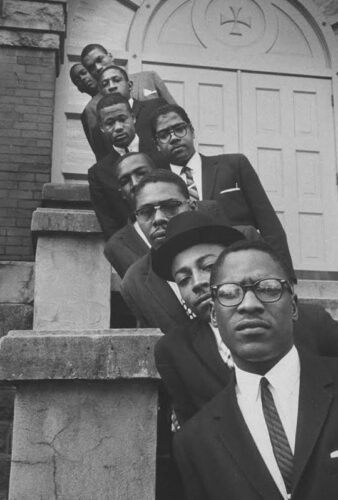
Elroy Embry and St. John Dixon were refused service and referred to the Cleveland Avenue Library, a Black library branch.
While white Montgomery residents had enjoyed access to the city’s public libraries since 1899, Montgomery was the last major city in Alabama to expand library services to serve Black residents. In 1948, after Black residents spent years petitioning the city for funding, the first Black library in Montgomery opened in a house owned by the Montgomery City Federation of Colored Women’s Clubs. In 1960, the Community House library was joined by a newly constructed but underfunded Black library branch on Cleveland Avenue.
In 1962, 18-year-old Robert Lee Cobb and five other Black teens “read-in” at the main public library. They were all denied service at the library and the city’s art museum, which were housed in the same building. Mr. Cobb filed a lawsuit to desegregate both institutions.
On August 7, 1962, the city’s art museum and library were ordered by a federal judge to desegregate. The city tried to prevent Black and white people from sitting or reading together by removing the tables and chairs, but Black residents were not deterred. Black children brought their own folding chairs and typewriter tables to make a mockery of the city’s tactics.
On August 11, 1962, Mr. Cobb became the first Black person to check out a library book at the formerly segregated main library. He selected William Shakespeare’s Much Ado About Nothing.
1961
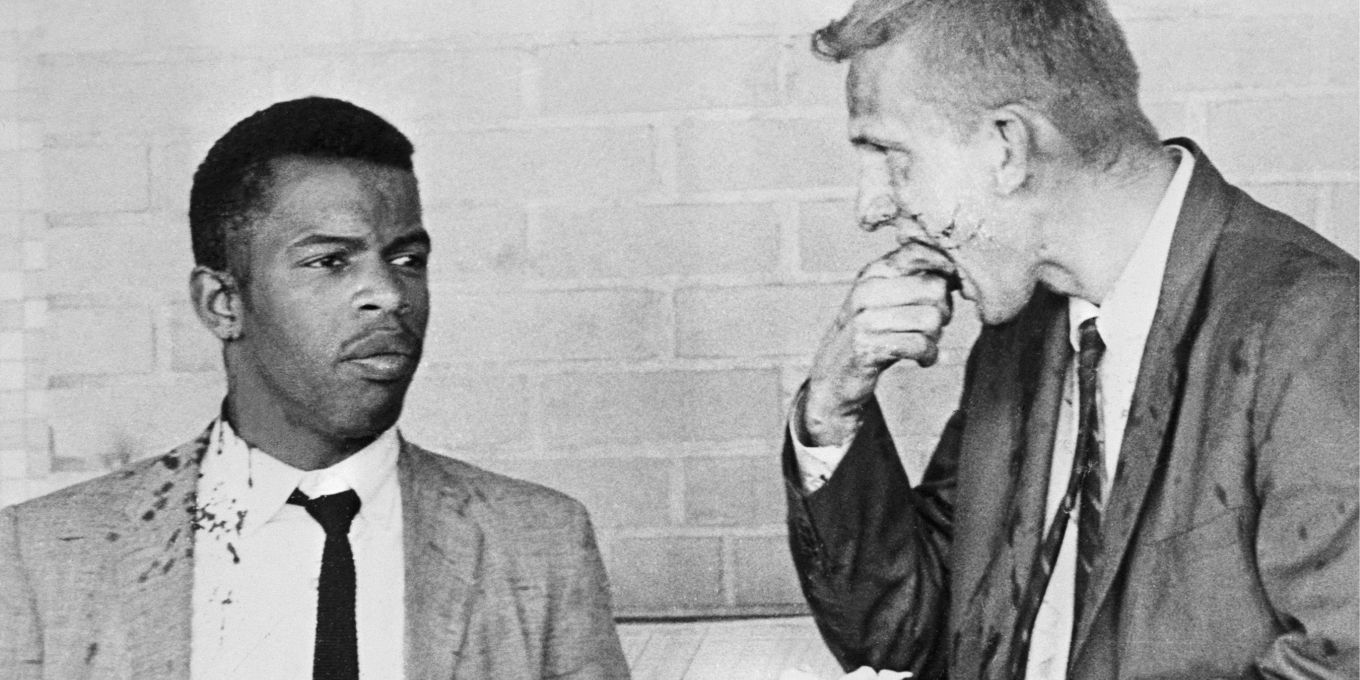
The interracial group of students were traveling by bus through the South to test enforcement of a recent Supreme Court decision holding that buses, waiting rooms, and restaurants serving interstate bus passengers must be desegregated.
A mob of more than 300 white people was waiting at the Greyhound station in downtown Montgomery, where they had been promised several minutes to launch their attack without police interference. The young college students were pulled out of the bus and viciously attacked with baseball bats, hammers, and pipes as police stood by, unwilling to “lift a finger to protect” them.
The next night, 3,000 white people rioted outside Montgomery’s First Baptist Church, forcing the Riders and their supporters, including Fred Gray, Dr. King, and Rev. Shuttlesworth, to shelter in the basement.
As the mob grew and became more violent, Dr. King called U.S. Attorney General Robert F. Kennedy, who sent U.S. Marshals to dispel the riot. The mob overturned cars, attacked Black homes with bullets and firebombs, and assaulted Black people in the streets. Martial law was declared in the city and National Guard troops were called in to restore order.
On November 1, 1961, U.S. District Court Judge Frank M. Johnson Jr. ordered bus and train terminals in Montgomery to desegregate as a result of the Freedom Rides.
1964
Johnnie and Arlam Carr sued after their son was barred from enrolling in Montgomery’s all-white Lanier High School, leading to U.S. District Court Judge Frank M. Johnson Jr.’s ruling requiring Montgomery schools to integrate.
On September 8, 1964, more than a decade after Brown, Montgomery public schools finally desegregated.
1965
When Dr. King and local leaders announced a voting rights march from Selma to Montgomery, Alabama Gov. George Wallace declared that the march “cannot and will not be tolerated” and commanded Alabama state troopers to block it.
On March 7, state and local police used billy clubs, whips, and tear gas to attack hundreds of nonviolent civil rights protesters on the Edmund Pettus Bridge in Selma, stopping their planned march to Montgomery. The day became known as “Bloody Sunday.”
1965
After police violently stopped the march from Selma to Montgomery, attorney Fred Gray filed for a federal court order to protect marchers, but the federal court had not ruled on March 9, when activists were determined to march again. Dr. King and local leaders decided to lead a second march to the Edmund Pettus Bridge, where demonstrators knelt in prayer before returning to Brown Chapel A.M.E. Church. This creative solution became known as “Turnaround Tuesday.”
1965
During a peaceful demonstration by around 600 voting rights activists three blocks from the Alabama Capitol, police officers on horseback beat demonstrators with clubs, ropes, and canes. One officer rode a motorcycle into the crowd, hitting a marcher. At least eight demonstrators were hospitalized as a result of the attack.
1965
The day after police beat voting rights activists during a peaceful demonstration in Montgomery, the Rev. Dr. Martin Luther King Jr. led nearly 4,000 demonstrators to the Montgomery County Courthouse to condemn the police attack.
1965
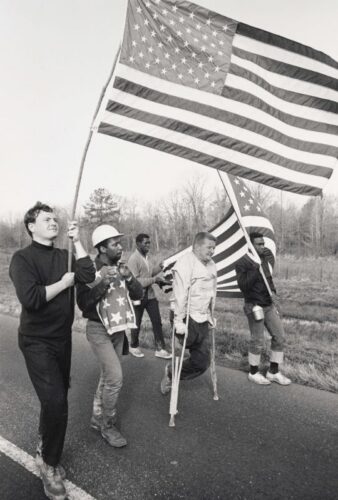
On March 21, 8,000 voting rights activists set out from Selma on the 54-mile walk to Montgomery.
1965
The crowd swelled during the march, and around 25,000 people had joined the marchers by the time they reached Montgomery, where the Rev. Dr. Martin Luther King Jr. addressed the marchers in front of the Capitol.
1965
As soon as the landmark legislation was enacted, Black voter registration surged dramatically across the South. Black turnout in the 1966 Alabama Democratic primary reached 80%. More than half of Black voters were newly registered in the previous year. Five Black people in Alabama were elected to public office in 1966, the first in half a century.
1970
They became the first Black people elected to the Alabama state legislature since Reconstruction.
1975
The surge in Black voters included around 200,000 in Alabama by 1975. The number of Black people elected to office in the Deep South soared from virtually none to about 1,000.
2013
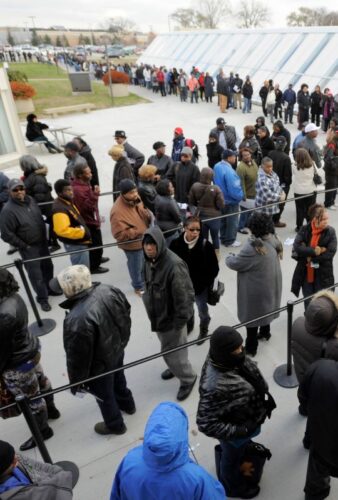
The ruling in Shelby County v. Holder—an Alabama case—struck down Section 4 of the Voting Rights Act, effectively gutting one of the nation’s most important and successful civil rights laws. It was the beginning of an attack on full political participation for Black Americans that continues today.
2026
The courage and commitment of Black people in Montgomery inspired a movement that spread across the country and the world. The end of codified racial segregation that had persisted for over a century and the passage of the Voting Rights Act in 1965 lifted this nation closer to its promise of liberty and justice for all.
All of us live in a world shaped by this period of astonishingly effective activism in Montgomery. We are all the heirs of this powerful movement that strengthened this country. We honor all who struggled, suffered, and died for justice in this community. We celebrate those who committed their lives to racial equality decades ago and those who continue to do so today. The battle is not over, and more work remains.
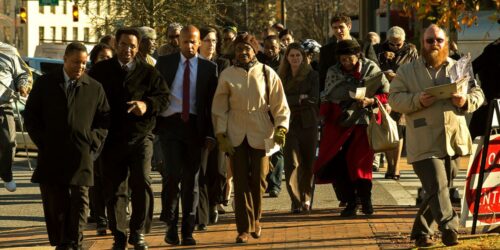
Experience the power of confronting injustice in this place, fueled by the deep knowledge gained at the Legacy Sites.